God heals the wounded heart from which forgiveness can grow.
We know that Christians are called to forgive. Jesus could hardly have been clearer about it. We pray, “forgive us our trespasses, as we forgive those who trespass against us.” Saint Paul tells us to bear with one another and forgive one another, “as the Lord has forgiven you” (Colossians 3:13).
But knowing that we are supposed to forgive and actually being able to forgive can feel like two very different things.
Sometimes we treat forgiveness as though it were simply a command we have failed to obey. We tell ourselves, You need to forgive. You should be over this by now. Why are you still angry? Why does this still hurt? Maybe you aren’t praying enough. Maybe you aren’t trying hard enough. Maybe you aren’t a very good Christian.
And so we stand over a wounded heart shouting, Heal. Heal. Heal.
But we would never treat a physical wound that way.
If we had a wound on our body that would not heal, we would not stare at it and demand that it close. We would not shame ourselves because it still hurt. The deeper the wound, the more likely we would be to seek help. If it became infected or continued to cause pain, we would go to a physician.
Perhaps wounds of the heart deserve the same humility.
Scripture tells us exactly what God does with wounded hearts:
“Healing the brokenhearted, and binding up their wounds.”
— Psalm 147:3
God does not stand over our wounds accusing us because they have not healed quickly enough. He binds them.
He is the Divine Physician.
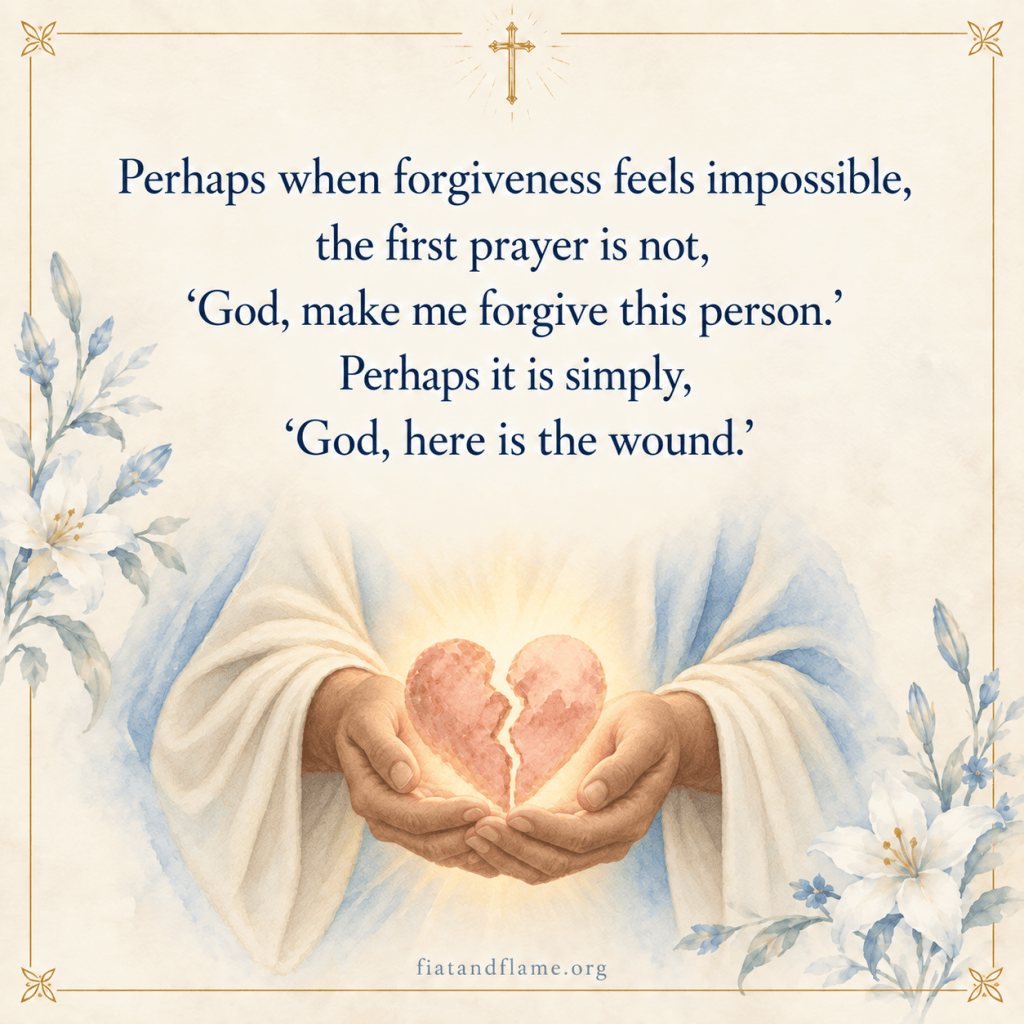
And perhaps when forgiveness feels impossible, the first prayer is not, God, make me forgive this person.
Perhaps it is simply, God, here is the wound. That is a very different prayer.
It stops pretending or trying to manufacture a feeling we do not possess. And it brings the injury into the presence of the One who can actually heal it.
Jesus says:
“Come to me, all you who labor and are burdened, and I will give you rest.”
— Matthew 11:28
Notice that He says come to Me.
Sometimes our instinct when we are struggling spiritually is to start doing more. Read another book. Listen to another podcast. Take another class. Find another technique. Try harder.
Those things can certainly have value. But there are wounds for which the answer is not more information.
The answer is presence. Becoming present toward God and allowing His presence to be known.
We bring the wound to Him just as we would bring an injury to a physician. We sit before Him in Adoration. We kneel near the tabernacle. We speak honestly to Him in prayer. We sit quietly with Scripture. We walk outside beneath the sky He created and allow ourselves simply to be with Him.
We do not have to arrive with the right words. We only have to arrive.
There is something deeply Catholic in this understanding of forgiveness. The Church does not teach us to deny the reality of our wounds. In fact, the Compendium of the Catechism of the Catholic Church acknowledges that forgiveness can seem impossible and then tells us where transformation occurs:
“The heart that offers itself to the Holy Spirit… can turn injury into compassion and transform hurt into intercession.” [1]
That is not pretending the injury never happened. It is not calling evil good.It is not saying that justice, accountability, or appropriate boundaries no longer matter.
It is the Holy Spirit doing within the heart what our own willpower cannot accomplish.
Saint John Paul II described forgiveness as “a personal choice, a decision of the heart,” but he immediately located that decision within something greater than human effort: the love of God. [2]
Christian forgiveness is not merely an act of emotional discipline. Its source is God.
Saint Paul writes:
“The love of God has been poured out into our hearts through the holy Spirit that has been given to us.”
— Romans 5:5
“Love poured into our hearts,” there is the image we may benefit from.We bring God a wounded heart, and He pours the healing ointment of His love into it.
Again.
And again.
And again.
Depending on the depth of the wound, this may take time. Some injuries penetrate deeply. Some involve betrayal, abandonment, abuse, injustice, or grief. The fact that pain remains does not mean God is absent, and it does not mean we have failed spiritually.
Forgiveness can begin as an act of the will long before our emotions catch up. We may be able to say, Lord, I do not want revenge. I place this person into Your hands. I want to want what You want. And then we allow God to continue His work, whatever it takes for as long as it takes.
Sometimes the “treatment” involves swallowing the proverbial ” bitter pill ” of continued, unavoidable association with the one who wounded us.
Sometimes it may involve willing or unwilling quarantine, having to remove ourselves completely from the source. Often we have little say in the best course of treatment.
The Lord Himself promises:
“I will give you a new heart, and a new spirit I will put within you.”
— Ezekiel 36:26
We do not create that new heart ourselves, God does.
This is why shame has no useful place in the healing process. Shame says, If you were holier, this would not hurt anymore.
Grace says, Bring Me what hurts.
Shame says, You should have fixed this by now.
Grace says, Come to Me.
Shame demands an immediate result.
Love sits beside the wound as it heals.
Think of the difference between a hurried physician and one who sits down, looks you in the eye, listens carefully, examines the wound, understands its history, and knows exactly what treatment it needs.
Even the best human physician cannot know us as thoroughly as God does. He knows where the wound began. He knows what was lost.He knows what we remember and what we are afraid to remember.
He knows the anger underneath the sadness and the sadness underneath the anger. And He is not impatient with us.
So if there is someone you know you are called to forgive, but the words I forgive seem unable to travel from your mind into your heart, perhaps you do not need to force them.
Bring God the heart first and sit with him.
Let Him listen to your pain. Let him see the tears. He is not afraid, he seen it before and likely much much worse. Let His love be poured into the places that still ache.
Forgiveness does not mean that the wound was insignificant. Forgiveness means refusing to let the wound become septic—endangering our spiritual life and, potentially, even our physical health.
And the same Jesus who prayed from the Cross, “Father, forgive them” (Luke 23:34), is capable of forming that same mercy within us.
Not through shame or force, but through his never-ceasing grace.
So today, instead of asking yourself, Why haven’t I forgiven yet? perhaps ask a different question:
What wound do I need to bring to the Divine Physician?
Then bring it to him and remain with Him. He knows how to heal a heart and is eager to do it every single time it gets hurt.
References
- Sacred Scripture: Psalm 147:3; Ezekiel 36:26–27; Matthew 11:28–30; Luke 23:34; Romans 5:5; Colossians 3:12–13. Scripture quotations are from the New American Bible, Revised Edition (NABRE). (USCCB Bible)
- [1] Compendium of the Catechism of the Catholic Church, no. 595, referring to CCC 2840–2845: “How is forgiveness possible?” The Church teaches that the heart offered to the Holy Spirit can transform injury into compassion and hurt into intercession. (Vatican)
- [2] St. John Paul II, Message for the XXXV World Day of Peace, No Peace Without Justice, No Justice Without Forgiveness, January 1, 2002, no. 8. He describes forgiveness as a decision of the heart whose measure is the love of God revealed in Christ. (Vatican)